


The secret to picking the Best Synthesizers for Beginners is finding an instrument that rewards your curiosity rather than punishing your lack of experience. A good synth should feel like an extension of your creative thoughts, not a complicated puzzle box you need a manual to solve.
You want immediate sound feedback and a layout that invites experimentation. Let us examine which tools actually help you start making music today.
Key Takeaways
- Prioritize models that offer direct hands-on control over sound parameters rather than deep software menus.
- Ensure the keyboard size fits your workspace because a controller that is too large will likely collect dust.
- Look for built-in sequencers or arpeggiators if you want to create full patterns without needing a computer.
- Verify if the unit contains an internal speaker so you can practice without dragging along external cables or headphones.
- Check for MIDI connectivity to guarantee the hardware works with the music software you already own.
| Fundamental Learning Guide |  |
Essential Techniques for Beginner Synth Players | Clear instructional focus | Logical learning progression | No hardware required | View on Amazon | Read Review |
| All In One |  |
Akai MPK Mini Play MK3 | Portable built-in speaker | Responsive dynamic keybed | Includes quality sounds | View on Amazon | Read Review |
| Deep Sound Explorer |  |
Arturia MiniFreak Hybrid Polyphonic Synthesizer | Powerful hybrid synthesis | Six voice polyphony | Versatile 64-step sequencer | View on Amazon | Read Review |
| Production Studio Foundation |  |
Akai MPK Mini MK3 Controller | Reliable hardware build | Intuitive drum pads | Deep DAW integration | View on Amazon | Read Review |
| Vocoder Creative Hub |  |
Novation MiniNova Analog Modeling Synth | Excellent vocal processing | Large polyphonic capacity | Portable desktop design | View on Amazon | Read Review |
| Quirky Nostalgic Sound |  |
Stylophone Original Pocket Synth | Extremely affordable | Unique playing interface | Highly portable | View on Amazon | Read Review |
| Experimental Wavetable Machine | 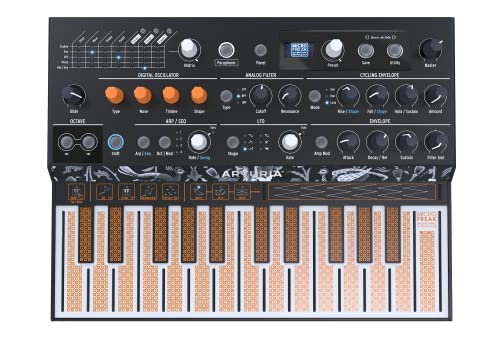 |
Arturia MicroFreak Hybrid Synth | Innovative touch interface | Versatile digital oscillators | Analog filter warmth | View on Amazon | Read Review |
| Expanded Control Workspace |  |
Akai MPK Mini Plus | Extra octave range | Dedicated hardware sequencer | MIDI and CV connectivity | View on Amazon | Read Review |
| Budget Learning Station |  |
Donner DMK 25 Pro | Educational course access | Informative OLED display | Helpful smart scales | View on Amazon | Read Review |
| Classic Analog Power |  |
Moog Messenger Monophonic Synth | Iconic analog sound | Intuitive step sequencer | High build quality | View on Amazon | Read Review |
More Details on Our Top Picks
-
Essential Techniques for Beginner Synth Players
If you are staring at a synthesizer and feel completely lost, start here. This guide focuses on the core concepts of synthesis, teaching you how to move beyond presets to actually shape your own sounds.
It acts as a map for your initial journey into electronic music. You will learn the essential signal flow of a synth without getting bogged down in overly technical jargon that often discourages newcomers.
- Instrument Type:Instructional Guide
- Additional Feature:Covers basic sound design
- Additional Feature:Explains signal flow
- Additional Feature:Beginner friendly concepts
-
Akai MPK Mini Play MK3
This unit is brilliant because it includes a built-in speaker and internal sounds. You do not need to connect to a computer to start playing immediately, which makes it perfect for quick practice sessions.
The dynamic keybed feels responsive enough for simple melodies. While it functions well as a standalone instrument, its true power appears when you connect it to your computer for deeper production work.
- Brand:Akai Professional
- Instrument Type:MIDI Keyboard Controller
- Key Count:25 keys
- Connectivity:USB
- Special Features:Built-in speaker and sounds
- Additional Feature:Includes MPC drum pads
- Additional Feature:Bundled software suite
- Additional Feature:Battery powered operation
-
Arturia MiniFreak Hybrid Polyphonic Synthesizer
Think of this as a playground for your ears. With six voices of polyphony and two sound engines, you can create complex, evolving textures that sound like they come from a much larger machine.
The 37 slim keys are great for those who value space but still want two full octaves of melodic range. The steep learning curve is the only trade-off here, but it rewards your patience with immense sonic variety.
- Brand:Arturia
- Instrument Type:Hybrid Synthesizer
- Key Count:37 keys
- Sound Generation:Hybrid digital/analog
- Connectivity:USB, MIDI, Audio
- Special Features:Aftertouch enabled keyboard
- Additional Feature:Built-in effects processor
- Additional Feature:Multi-mode SVF filter
- Additional Feature:Step sequencer included
-
Akai MPK Mini MK3 Controller
This is the standard choice for anyone setting up a home studio on a budget. It offers eight backlit pads that make programming drum beats feel tactile and intuitive.
You get total control over your digital instruments through the eight assignable knobs. Just remember that this unit produces no sound on its own and requires a computer to function as your musical instrument.
- Brand:Akai Professional
- Instrument Type:MIDI Keyboard Controller
- Key Count:25 keys
- Connectivity:USB
- Special Features:NKS integration
- Additional Feature:Backlit drum pads
- Additional Feature:Assignable control knobs
- Additional Feature:Software bundle included
-
Novation MiniNova Analog Modeling Synth
If you want to turn your voice into a robotic instrument, the built-in vocoder makes this your primary option. It uses analog modeling to recreate vintage textures in a compact, portable package.
The 18-voice polyphony ensures that you can play thick chords without notes cutting off prematurely. While the menu navigation can feel dense, the animate buttons give you instant control over your performance.
- Brand:Novation
- Instrument Type:Analog Modeling Synthesizer
- Key Count:37 mini keys
- Sound Generation:Analog modeling
- Connectivity:USB
- Special Features:Built-in vocoder
- Additional Feature:256 preset patches
- Additional Feature:Five effects per voice
- Additional Feature:Performance animate buttons
-
Stylophone Original Pocket Synth
This is not a workstation for complex studio production, but it is pure, unfiltered musical fun. You play it by touching the metal surface with a stylus, which creates a distinct, buzzing sound.
It functions as a great conversation starter and a tool for creating lo-fi textures. It lacks modern features like MIDI or polyphony, so keep your expectations focused on simple, monophonic melodies.
- Brand:Stylophone
- Instrument Type:Pocket Synthesizer
- Sound Generation:Analog
- Connectivity:Headphone out
- Additional Feature:Battery operated
- Additional Feature:Stylus control included
- Additional Feature:Built-in speaker
-
Arturia MicroFreak Hybrid Synth
The MicroFreak is a wild departure from traditional keyboards, featuring a capacitive touch PCB that feels unlike anything else. Its combination of digital wavetable oscillators and analog filters creates sounds that are both crisp and warm.
It supports polyphonic aftertouch, allowing for expressive playing techniques that are usually reserved for high-end gear. The unconventional keybed might take a moment to adjust to, but it opens up new ways of playing.
- Brand:Arturia
- Instrument Type:Hybrid Synthesizer
- Key Count:25 keys
- Sound Generation:Wavetable and Digital
- Connectivity:MIDI, CV, USB
- Special Features:Polyphonic aftertouch
- Additional Feature:Sequencer functionality
- Additional Feature:Multi-mode oscillator types
- Additional Feature:Capacitive touch keyboard
-
Akai MPK Mini Plus
When you need more room to play, the 37 keys on this model provide a much more comfortable experience than standard 25-key controllers. It adds a hardware sequencer and dedicated MIDI ports, making it a bridge between software and hardware gear.
This is a step up for those who have outgrown smaller controllers but still want a compact footprint. It is a capable central hub for a growing electronic setup.
- Brand:Akai Professional
- Instrument Type:MIDI Keyboard Controller
- Key Count:37 keys
- Connectivity:USB, MIDI, CV/Gate
- Special Features:Internal sequencer
- Additional Feature:MPC drum pads
- Additional Feature:Compact design
- Additional Feature:Software bundle included
-
Donner DMK 25 Pro
This unit arrives with a significant advantage for new players, specifically the 40 included teaching courses. It serves as a dual-purpose tool that helps you learn piano theory while acting as a functional MIDI controller.
The OLED display is a rare and helpful inclusion, giving you immediate visual feedback on your settings. It is a solid choice for someone who wants to learn the basics without committing to a massive studio investment.
- Brand:Donner
- Instrument Type:MIDI Keyboard Controller
- Key Count:25 keys
- Connectivity:USB-C
- Special Features:Built-in arpeggio
- Additional Feature:Eight drum pads
- Additional Feature:Includes DAW software
- Additional Feature:Smart scale modes
-
Moog Messenger Monophonic Synth
Moog is synonymous with thick, punchy bass, and this synthesizer delivers that signature analog character in a modern package. It is a monophonic machine, which means it excels at lead lines and growling low-end parts.
The 64-step sequencer allows you to build intricate patterns that stay perfectly in time. If you want to learn sound design on a focused, high-quality instrument, this is an excellent choice.
- Brand:Moog
- Instrument Type:Analog Synthesizer
- Key Count:32 keys
- Sound Generation:Analog
- Connectivity:USB, MIDI
- Special Features:RES BASS compensation
- Additional Feature:256 preset patches
- Additional Feature:Modern sequencing tools
- Additional Feature:Dedicated bass design
Frequently Asked Questions
Do I need an external amplifier or speakers?
Most synthesizers do not have built-in speakers. You will need to connect the unit to a pair of studio headphones or powered monitor speakers to hear your music.
What is the difference between a synth and a MIDI controller?
A synthesizer generates its own sound using internal electronics. A MIDI controller is just a keyboard that sends signals to your computer, meaning it makes no noise on its own.
Is it hard to learn how to patch a synth?
It might look like the cockpit of a jet at first, but the basics of subtractive synthesis are easy to grasp. Focus on learning how oscillators, filters, and envelopes work together to shape a single wave into a finished sound.
Can I use my synth with a digital audio workstation?
Yes, almost every modern synth acts as an interface. By using a USB cable, you can record your performances directly into software like Ableton or Logic.
Do I need to learn piano to use a synthesizer?
You do not need to be a concert pianist to enjoy electronic music. Many great synth players use simple arpeggios and rhythmic sequences to create complex soundscapes without needing advanced keyboard skills.