

A few decades ago, starting your own home studio required a small fortune and enough floor space to house a modest library. Now, the wall between you and your first track is paper thin, as technology has shrunk massive signal paths into compact, high-performance machines.
Choosing from the Best Beginner Synthesizers is about finding the right entry point for your specific creative rhythm. Whether you crave tactile knobs or simple keys, these tools turn abstract noise into melody.
Key Takeaways
- Prioritize keyboards with velocity sensitive keys so you can express dynamic changes in your playing volume.
- Check if the unit includes a built-in speaker because that allows for instant sketching without plugging into an external audio interface.
- Look for models that function as both a standalone sound source and a controller for your computer software.
- Choose a hybrid instrument if you want the stability of digital oscillators paired with the warmth of an analog filter.
- Confirm the number of voices, or polyphony, to ensure you can play chords instead of just single notes if your musical style demands it.
| Ultimate Portable All-Rounder |  |
Akai MPK Mini Play MK3 | Built-in speaker for mobility | Responsive dynamic keybed | Compact MPC pads | View on Amazon | Read Review |
| Versatile Sound Designer |  |
Novation MiniNova Analog Modeling Synthesizer | Powerful analog modeling engine | Fun built-in vocoder | Extensive preset library | View on Amazon | Read Review |
| Creative Hybrid Powerhouse |  |
Arturia MiniFreak Hybrid Synthesizer | Six-voice polyphonic hybrid engine | Deep 64-step sequencer | Expressive aftertouch keys | View on Amazon | Read Review |
| Generative Patching Explorer |  |
Moog Labyrinth Parallel Synthesizer | Unique generative sequencing | Intuitive patch bay | High quality analog components | View on Amazon | Read Review |
| Charming Retro Minimalist |  |
Stylophone Original Pocket Synth | Very affordable entry point | Iconic retro aesthetic | Pocket-sized design | View on Amazon | Read Review |
| Wild Sonic Experimenter | 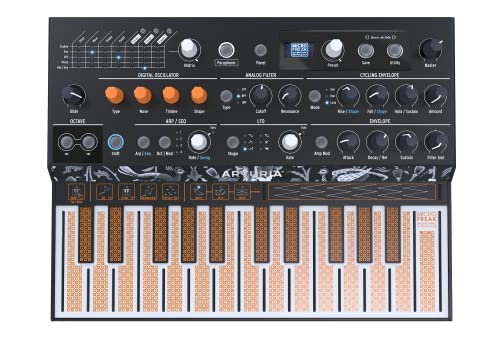 |
Arturia MicroFreak Hybrid Synth | Unique touch keyboard | Diverse digital oscillator types | Authentic analog filter | View on Amazon | Read Review |
| Feature-Rich MIDI Controller |  |
Donner DMK 25 Pro | Helpful OLED display | Built-in arpeggio functions | Included learning resources | View on Amazon | Read Review |
| Minimalist Desktop Companion |  |
Akai LPK25 MIDI Controller | Compact, slim design | Simple setup process | Responsive synth-action keys | View on Amazon | Read Review |
| Vector Morphing Specialist |  |
Behringer Pro VS Mini | Four morphing oscillators | Lush analog filter | Portable five-voice architecture | View on Amazon | Read Review |
| Lo-Fi Effect Laboratory |  |
Korg Monotron Delay | Classic analog delay sound | Extremely portable and light | Fun ribbon interface | View on Amazon | Read Review |
More Details on Our Top Picks
-
Akai MPK Mini Play MK3
If you want an instrument that functions as both a standalone synth and a controller, this is your best starting point. It packs a built-in speaker and hundreds of internal sounds, meaning you can make music without turning on a computer.
The dynamic keybed feels responsive enough for beginners to learn proper expression. Just remember that the internal sound library is fixed, so you will eventually need to connect it to a computer to access more diverse software instruments.
- Brand:Akai Professional
- Type:MIDI Controller and Synth
- Key Count:25 keys
- Power Source:USB or Battery
- Additional Feature:Hundreds of onboard sounds
- Additional Feature:Integrated sustain pedal input
- Additional Feature:Includes production software suite
-
Novation MiniNova Analog Modeling Synthesizer
This unit excels at analog modeling, giving you that classic warm synth character without the high cost of vintage hardware. It features a built-in vocoder, which is a fantastic tool if you are interested in transforming your voice into robotic or melodic textures.
You get 256 preset sounds right out of the box, offering plenty of variety to explore immediately. Be aware that the mini keys are quite small, so players with larger hands might find fast melodies a bit cramped.
- Brand:Novation
- Type:Analog Modeling Synth
- Key Count:37 keys
- Polyphony:18 voices
- Power Source:USB or DC
- Additional Feature:Five effects per voice
- Additional Feature:Animate buttons for performance
- Additional Feature:Dedicated filter controls
-
Arturia MiniFreak Hybrid Synthesizer
This is the machine for those who want to blend digital flexibility with analog filter grit. With six voices of polyphony, you can play full chords rather than just single-note lines, which is essential for composing complete songs.
The 64-step sequencer makes it incredibly easy to build complex rhythmic patterns. While the interface is intuitive, the sheer number of modulation options might feel a little overwhelming during your first few sessions.
- Brand:Arturia
- Type:Hybrid Synthesizer
- Key Count:37 keys
- Polyphony:6 voices
- Oscillators:2 engines
- Power Source:DC Adapter
- Additional Feature:State variable analog filter
- Additional Feature:Three built-in effects engines
- Additional Feature:Matrix modulation routing
-
Moog Labyrinth Parallel Synthesizer
This is a semi-modular synth designed for those who enjoy the process of creating evolving, organic soundscapes. Instead of traditional keys, it uses a patch bay to route signals, allowing for unique generative music that shifts and changes on its own.
Because it is parallel and generative, you can create complex textures that sound like a living, breathing organism. It lacks a keyboard, so it functions best as a specialized tool for experimental sound design rather than a traditional melodic instrument.
- Brand:Moog
- Type:Semi-modular Analog Synth
- Oscillators:Dual oscillators
- Power Source:DC Adapter
- Additional Feature:Voltage controlled wavefolder
- Additional Feature:Dual sequencer integration
- Additional Feature:Parallel signal processing
-
Stylophone Original Pocket Synth
If you need something that is purely for fun and extremely portable, look no further than this classic design. You play it using a metal stylus to touch the keyboard, which creates a distinct, buzzing analog tone that is instantly recognizable.
It is a fantastic tool for learning the very basics of monophonic synthesis. Do not expect professional recording studio features here, as it is designed for simple, immediate musical expression.
- Brand:Stylophone
- Type:Pocket Analog Synth
- Power Source:Battery
- Additional Feature:Metal stylus interface
- Additional Feature:Vibrato toggle switch
- Additional Feature:Built-in speaker
-
Arturia MicroFreak Hybrid Synth
The capacitive touch keyboard on this synth is unconventional, offering a completely different feel than a traditional piano-style controller. It shines because of its wavetable and digital oscillators, which provide sounds you simply cannot find on basic analog machines.
It is a true polyphonic aftertouch machine, allowing you to manipulate sounds by how hard you press individual keys. Beginners should note that the touch surface takes a little time to master if you are used to physical keys.
- Brand:Arturia
- Type:Hybrid Synthesizer
- Key Count:25 keys
- Power Source:USB
- Additional Feature:Polyphonic aftertouch support
- Additional Feature:Mod matrix configuration
- Additional Feature:Arpeggiator and sequencer
-
Donner DMK 25 Pro
This controller is packed with value-added features like an OLED screen and 16 smart scales to help you stay in key. It is designed to be a DAW-integrated center for your studio, giving you physical control over your computer software.
The inclusion of teaching courses makes it an excellent choice for a total beginner starting from scratch. Be aware that the software setup process can take some time to fine-tune for your specific computer.
- Brand:Donner
- Type:MIDI Keyboard Controller
- Key Count:25 keys
- Power Source:USB-C
- Additional Feature:Eight drum pads
- Additional Feature:16 selectable smart scales
- Additional Feature:DAW software integration
-
Akai LPK25 MIDI Controller
If your workspace is small and you only need a simple keyboard to input notes into your computer, this is the perfect solution. It is a plug-and-play device that keeps things extremely simple without unnecessary buttons or screens.
The keys are synth-action, which provides a light, quick response ideal for playing fast melodies. It does not have drum pads or knobs, so you will need to rely on your computer mouse for more advanced production tasks.
- Brand:Akai Professional
- Type:MIDI Keyboard Controller
- Key Count:25 keys
- Power Source:USB
- Additional Feature:Dedicated arpeggiator button
- Additional Feature:Octave up and down switches
- Additional Feature:Sustain pedal input
-
Behringer Pro VS Mini
This portable synth uses vector morphing oscillators to create sounds that shift over time as you move between different wave shapes. With five voices, it offers enough depth for thick, evolving pads and leads that sound much larger than the box suggests.
The analog low-pass filter adds a nice, smooth warmth to the digital sounds. It is a small unit, which makes it great for travel, though the small interface requires some menu navigation to access deeper settings.
- Brand:Behringer
- Type:Hybrid Synthesizer
- Polyphony:5 voices
- Oscillators:4 per voice
- Power Source:USB
- Additional Feature:16-step internal sequencer
- Additional Feature:Built-in arpeggiator
- Additional Feature:Vector joystick control
-
Korg Monotron Delay
This tiny device is essentially an analog filter and delay unit that you play with a ribbon controller. It is perfect for adding spacey, psychedelic textures to your existing gear or simply for making weird noises on the go.
The ribbon controller allows for smooth, sliding glissandos that are impossible on standard keyboards. Just keep in mind that it is very limited in scope, functioning more like a sound-mangling toy than a primary instrument.
- Brand:Korg
- Type:Ribbon Analog Synth
- Power Source:Battery
- Additional Feature:Built-in speaker
- Additional Feature:Auxiliary input for processing
- Additional Feature:Self-oscillation capability
Frequently Asked Questions
Do I need a computer to use a synthesizer?
You do not need a computer to play or enjoy a hardware synthesizer. Most units have built-in speakers or headphone jacks so you can start making noise the moment you plug them in. However, connecting to a computer opens up recording capabilities and allows you to store your custom patches. It is a helpful addition but certainly not a requirement for the initial setup.
What is the difference between a synth and a MIDI controller?
A MIDI controller has no internal sound engine, so it is just a set of keys that sends data to software on your laptop. A synthesizer creates actual audio signals using its own internal hardware. If you want to play music without having a laptop nearby, you definitely need an actual synthesizer. Think of a MIDI controller as a steering wheel without a car attached to it.
Are monophonic synths too limited for beginners?
Not at all, provided you understand their strengths. Monophonic synths are excellent for learning the fundamentals of subtractive synthesis because you are forced to focus on one voice at a time. They produce the thick, aggressive basslines and leads that define many genres of music. You might eventually want a polyphonic synth for chords, but starting with a mono synth is a classic rite of passage.
Can I use a synthesizer to record a full song?
You can, but you will need an audio interface to get the sound from your synth into your recording software. Most professional studios use this method to capture the high-quality output of hardware gear. If you want to record multiple parts, you will layer them one by one. This is a common workflow called multitracking that lets you build a complex arrangement with just a single instrument.
How long should a beginner expect to spend learning to program sounds?
Learning to program a synth is a journey that lasts a lifetime, but you can understand the basics of oscillators and filters in a few weeks of consistent practice. Start by tweaking the presets that come with the machine to see how they react to your changes. Do not worry about becoming an expert overnight. Focus on understanding how the envelope generator shapes the volume of your sound, and the rest will start to fall into place.